University Home Page
 Faculty of Engineering and Technology
Faculty of Engineering and Technology
Department Of Agricultural & Biosystems Engineering
 Faculty of Engineering and Technology
Department Of Agricultural & Biosystems Engineering
Faculty of Engineering and Technology
Department Of Agricultural & Biosystems Engineering
The philosophy of the programme therefore is to promote, within the student, the science and art of engineering in agriculture and to build in them capacity for high sense of self-reliance, coupled with sound academic and practical discipline towards the attainment of the national goals and objective of rapid industrialization, food self-sufficiency and technological emancipation.
DUTIES AND RESPONSIBILITIES OF THE DEPARTMENT
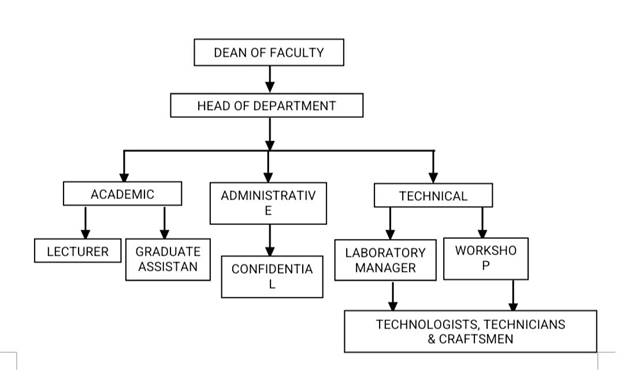
The Department has two Boards that are responsible for the decision-making process in matters that strictly concern the Department. These Boards are: (i) The Departmental Board; and (ii) The Board of Examiners. The Departmental Board, which is made up of all senior staff of the Department, including senior non-academic staff, deliberates on issues of general interest to the Department. The Departmental Board of Examiners is made up of only academic staff, and it considers academic matters as they affect the students. To facilitate the activities of these Boards, members of staff are allocated specific duties as well. Examples of these include having staff in charge of issues like Examination, Postgraduate matters, and Students Industrial Work Experience Scheme (SIWES). The Department is involved in teaching and supervising students’ projects, theses and dissertations for the undergraduate and postgraduate students. The Department gives professional advice about their career challenges and is fully engaged in the administration of the unit.
Structure of the Department
PROSPECTS OF THE DEPARTMENT
There are prospects for the department through the Workshop in a number of areas, are as follows:
Students Attachment– The Department of Agricultural and Biosystems Engineering has signed a Memorandum of Understanding (MOU) with the National Centre for Agricultural Mechanisation (NCAM) to facilitate the training of its students in agricultural machine design.This collaboration is aimed at strengthening students’ practical and technical competencies in the design, development, and evaluation of agricultural machinery, while fostering industry–academia linkage and hands-on innovation in agricultural mechanisation.
Training of Tractor Operators and Mechanics– The Department of Agricultural and BiosystemsEngineering has officially signed a Memorandum of Understanding (MOU) with Unilorin Holdings Ltd to establish a Tractor Driving and Maintenance School. This partnership is aimed at promoting practical skills development, professional training, and capacity building in tractor operation, servicing, and maintenance. The initiative is expected to enhance technical competence among students, graduates, and other interested participants, while contributing to agricultural mechanisation and employment generation.
Tractor Services – The Department of Agricultural and Biosystems Engineering provides tractor services to the university community. These services support land preparation, ploughing, harrowing, transportation, and other mechanised agricultural operations, thereby facilitating research, teaching, and practical farming activities within the university.
Fabrication of Small Farm Machines– The Workshop had welders, machinists and correspondingly good machines; the Workshop was a mini-fabrication hub. Lecturers and students with designs of machines that needed fabrication did so conveniently in the Workshop. Small farm machines could be fabricated at the Workshop with proper funding.
© 2026 University of Ilorin
 Department of Agricultural & Biosystems Engineering, Faculty of Engineering, University of Ilorin, Ilorin, Nigeria
 07066576605
 hodagricandbiosysengrg@unilorin.edu.ng